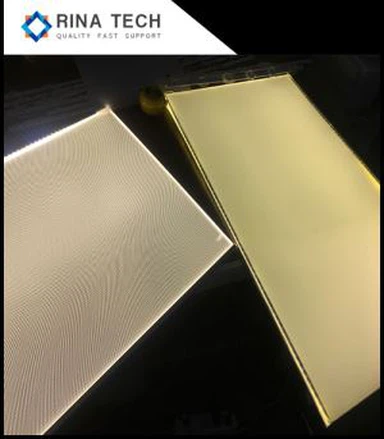
Structure design of light guide plate of TFT LCD liquid crystal display module
Mar 28, 2022
The light guide plate (LGP) of the TFT LCD liquid crystal display module is a material that works on the principle of light reflection and light scattering. This paper mainly introduces the structural design of the light guide plate of the TFT liquid crystal display screen. The main evaluation items include the production method, assembly structure, effective light-emitting area and gap, position fixation, and warpage control.


1. Production method. The light guide plate is usually formed by injection molding and cutting. Injection molding uses the injection molding process to inject plastic particles into light guide plates with smooth surface on one side and optical dots on the other side, such as ultra-thin light guide plates and small light guide plates. Cutting to make a light guide plate is to use a large light guide plate to cut into the desired shape of the light guide plate, and then use a material with high reflectivity and no light absorption on the side of the cut light guide plate, and use a screen printing process on the bottom of the light guide plate. Print with circular or square dots to diffuse light. When the light hits the dots, the light will be reflected in all directions, and then the reflection conditions will be destroyed and the light will be emitted from the front of the light guide plate. In order to ensure that the probability of light reflecting in all directions is roughly the same, and to make the light-emitting surface of the light guide plate emit light uniformly, various density and different sizes of dots must be used. As a set, there is also a reflective film under the light guide plate, which is used to reflect the light leaked from the bottom surface back into the light guide plate, so as to improve the utilization rate of light and increase the brightness.
Second, the assembly structure. The assembly structure of the light guide plate is divided into two types: reverse installation and normal installation. Reverse installation is to integrate the light guide plate and the plastic frame into a whole by designing a fitting structure on the plastic frame and the light guide plate. The light utilization rate of the reverse-mounted light guide plate is low, and it is generally limited to small-sized products. Formal installation is to assemble one by one from the back panel, which is more convenient to assemble and is mainly used for medium and large size products. The formal structure is easy to disassemble and rework the parts, but the disadvantage is that the assembly process is increased. Although the increase in the number of processes for formal installation leads to an increase in cost, this structure is of great help in improving the light utilization rate of the light guide plate.
3. Effective light-emitting area and gap. Within the viewing angle specification, it is required that the corresponding display screen can be illuminated by light, so the design of the light guide plate needs to fully consider the effective light-emitting area. The material of the light guide plate will expand or contract with changes in ambient humidity or temperature, so the design of the gap between the light guide plate and the adjacent components must consider the amount of expansion and contraction in addition to the tolerance. If the light guide plate interferes with the connecting structure, noise will occur when shaking. Pay special attention to the design of the gap between the light guide plate and the plastic frame.
Fourth, the location is fixed. The fixed position of the light guide plate is designed to prevent the light guide plate from loosening within the gap range after being affected by external force. The position is fixed by means of concave-convex fitting. Design the convex part on the light guide plate and design the concave part on the plastic frame. The design of the convex part of the light guide plate needs to ensure that the problem of stress concentration does not occur after being impacted by external force.
5. Warpage control. Warpage is the main defect of the light guide plate. After the reliability test of high temperature and high humidity, it will expand and warp due to the high water absorption rate. When the light guide plate is warped, it will cause the adjacent optical film to wrinkle, or interfere with the display screen, resulting in abnormal display. As a countermeasure, when designing the light guide plate, the allowable amount of warpage of the light guide plate should be specified. When making the light guide plate, it is necessary to adjust the molding conditions, and in the structural design, it is necessary to appropriately increase the gap between the light guide plate and the plastic frame.